Week 9-SITE Reveal Day, 10/5!

This was the day we had been waiting for, the day we found out our 2-year home while serving the Peace Corps. First, we were told the process of site selection and then we were prepared for the varying emotions. Some will be happy, some sad, some angry or not in agreement with their placement. Honestly, I was emotional just thinking it was a miracle that I was here at all and how much I miss Steve. I would leave today if I could just have another normal day with Steve but that is not possible, so I am happy to be here.

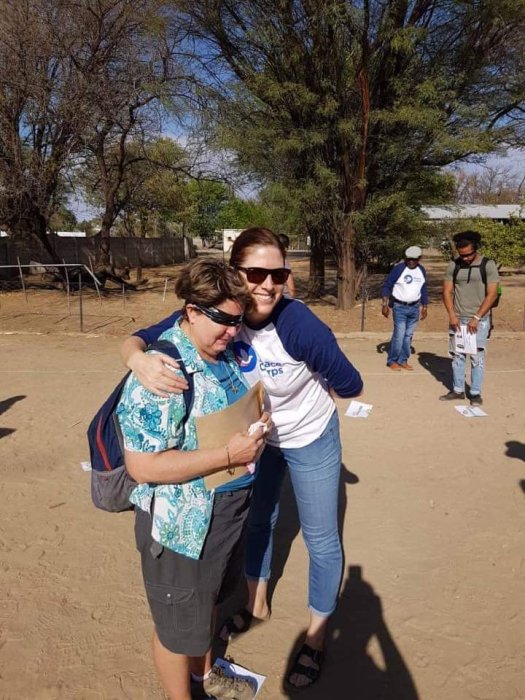
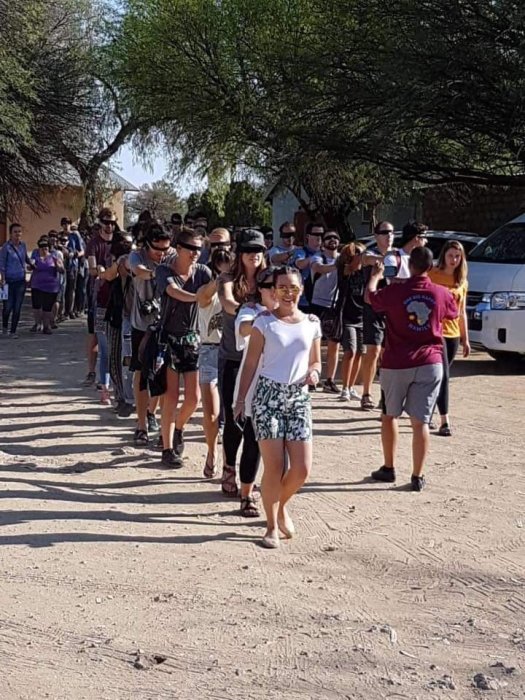
We were blindfolded and walked to our spot on the map of Namibia that was laid out in the yard. We were handed a packet about our site. When all the trainees were in position there was a countdown, we removed our blindfolds, looked down to see our site name, and then opened our packets.

I will teach at a secondary school in a city of @30,000 about 300 km north of the capitol, Windhoek. They need a Physical Science teacher for 8-9 graders and a Math teacher for 8-10 graders. According to all the locals, it is an exceptional school and a nice town. I will share a 3-bedroom teacher house on the school premises with 2 women and the 5-month-old son of one of the women. The women are not Peace Corps volunteers (PCV).

My packet included a letter from the PCV that I am replacing, and she says the women are terrific roommates. My packet also says it is a modern house with electricity, running water, indoor toilet, shower, refrigerator and a note saying that I am lucky to have all this, and they may not always work.

I guess I am not living in a mud hut after all!

All for now, with all my love

Here’s some photos of the day
Week 8 a little history

Note: this ‘history’ is what I have picked up in the 8weeks I’ve been in country. I don’t have references.

When Western Europeans (mostly Dutch, German, British) colonized what is now Namibia, sometimes they “relocated” many indigenous tribes and ethnic groups. They usually did this because they wanted their land or some of the tribes were nomadic and they would periodically disturb the lands the colonists had cultivated. When Namibia was part of South Africa and apartheid was enforced, the blacks and coloreds (i.e. Indigenous tribes and ethnic groups) were “relocated” even more. Many towns and cities still have a “location”, the area where mostly blacks and coloreds live. Blacks and coloreds are free to live anywhere now but due to financial constraints and/or family history of generations living in the location, they are still largely populated by blacks and coloreds. Many locations are divided into sections by specific tribes or ethnic groups such as the Damara-Nama area, the Herero area, the Owambo area, etc. Unfortunately, this is also a result of apartheid when it was against the law for tribes to mix not just according to skin color.

Some sections have shacks of corrugated metal with no indoor plumbing or electricity and other sections have modern homes complete with flat screen TV and cable.

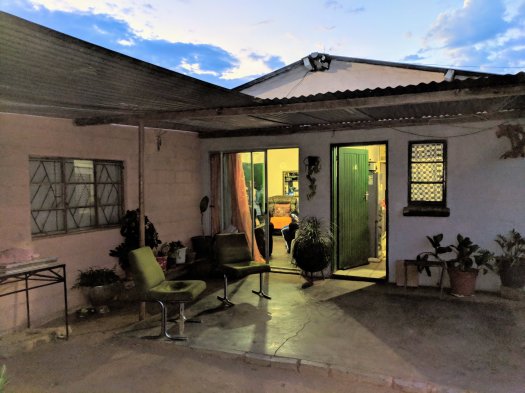
Tierra, a Peace Corps Volunteer (PCV) who teaches at the primary school in the Omaruru location, hosted four trainees to observe at her school and to see how she has integrated into her community. Since she only has a 1-bedroom home, we took our meals with her, but we slept across the street at her host mother’s house. This visit gave us another view of education in Namibia and an up-close, personal look at life as a PCV.

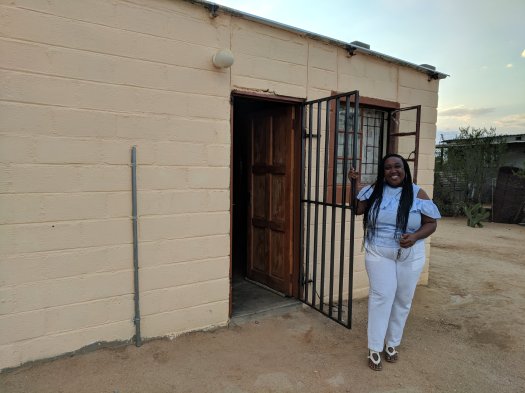
Tierra’s cute, little house

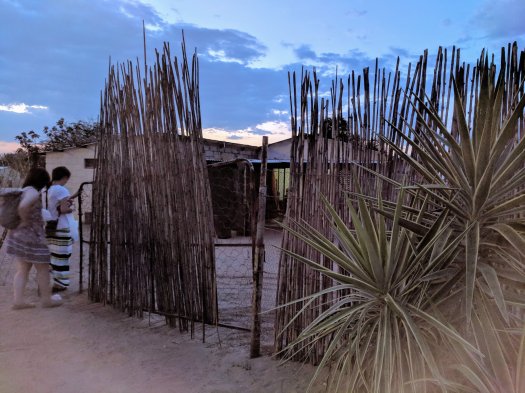
Entering host Mom’s property
Bougainvillea outside of school office
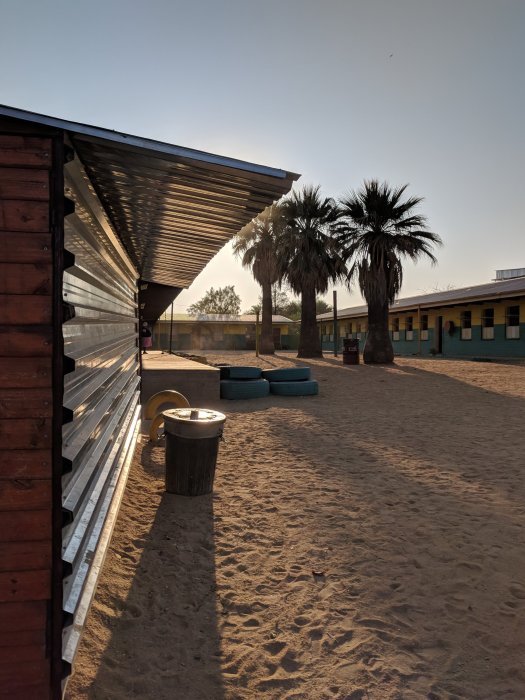
The school grounds in the morning
Host Mom’s patio area and entrance to the house. Very comfortable!
The school has a lovely garden. This school is well cared for and well loved
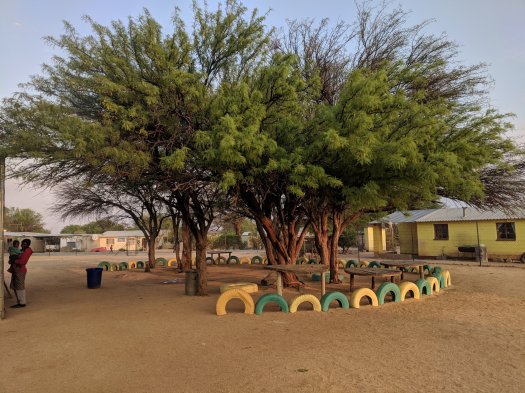
Shade trees on the school property

All for now, with all my love

A Damara tradition

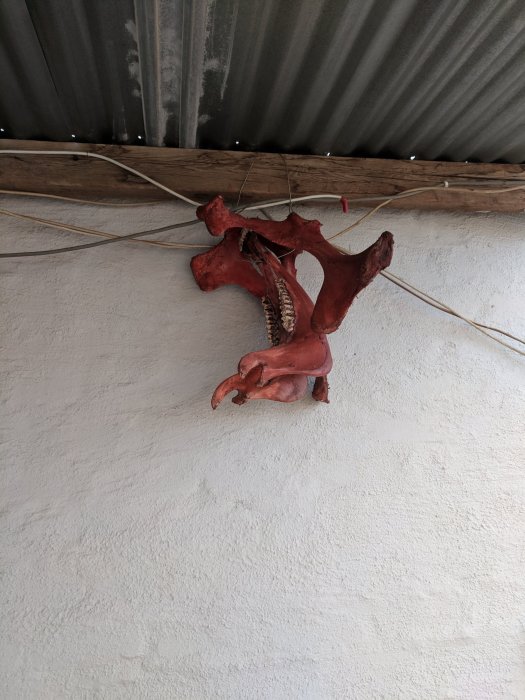
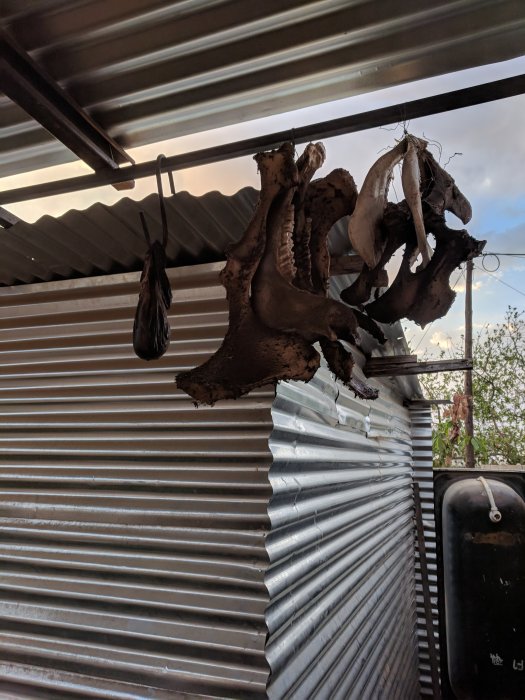
I learned this weekend that a Damara tradition is to slaughter a cow for a wedding. The meat from the pelvic area is served only to the older women that had or have good marriages. They are very careful while cutting the bones and cooking the meat from those bones to not break any of the bones. It is bad luck if a bone breaks in this process and is a sign the new wife will not bear children. The bones are then cleaned and hung at the house who hosted the wedding, usually the bride but not always. Sometimes they also dye the bones a ucher color. The bones are hung by themselves for a year and then they can be moved where earlier wedding bones are hung or to the newlyweds’ home.

Another tradition is to hang a white flag on the roof for a wedding which stays until the weather dissolves it. They hang a Black flag for a death but only until the funeral is complete.

All for now, with all my love

Pictures of pelvic bones from a September 1 wedding and another of several from earlier weddings. The video is a wind/rainstorm with the white flag blowing. These were all taken yesterday where I am staying until Wednesday. I will send more about this visit in another post.

God winks/Steve winks

During our Braii (BBQ), at my host family’s house, last Saturday evening, they started playing several Vince Gill songs and then other country songs by older artists such as Chet Atkins. I really couldn’t believe these would be in their playlist. If you knew Steve, you knew how much he liked country music and particularly these artists. I shared this with my family at home and my niece called it a God wink letting me know Steve is with me in spirit. I love that, and I got more this week.

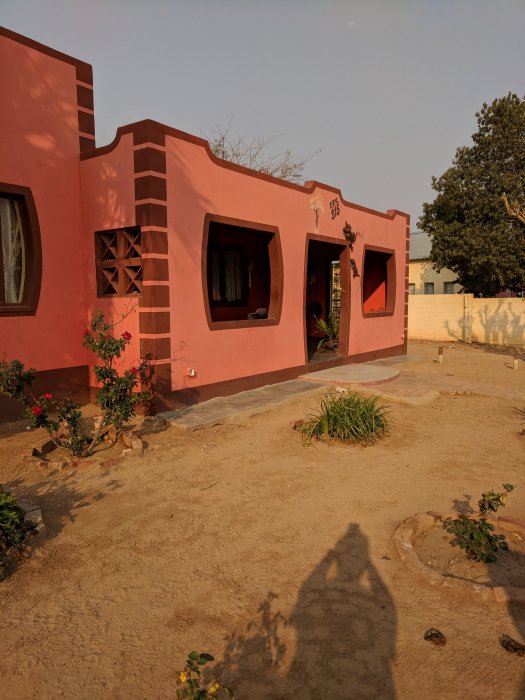
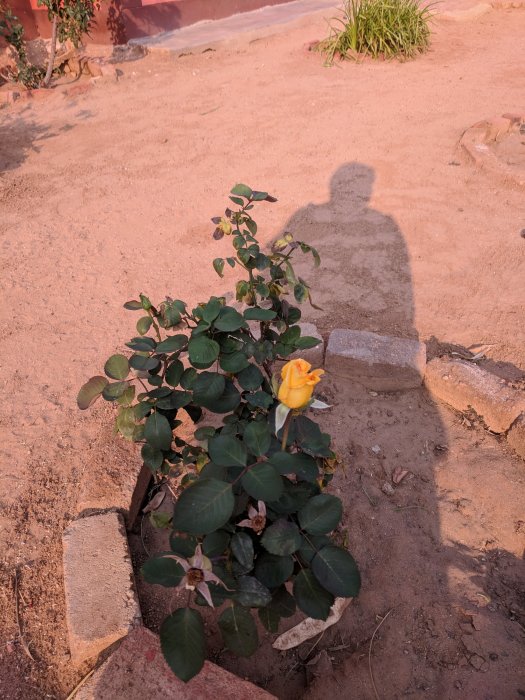
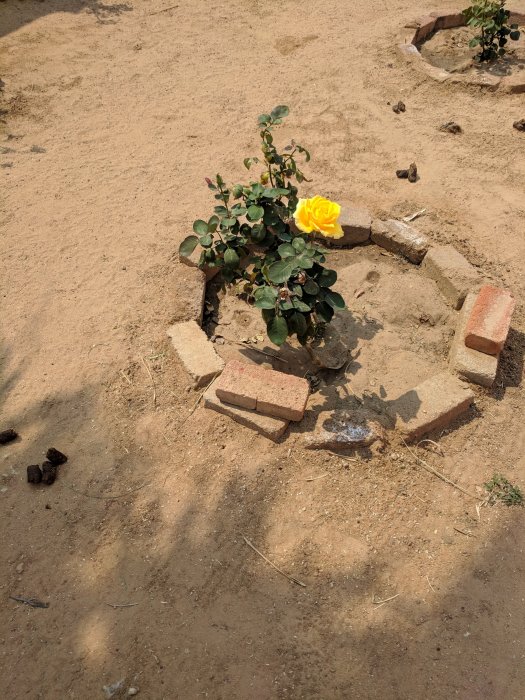
Our 31st wedding anniversary would have been last Wednesday, September 19 so Steve was on my mind even more than usual. My host family mom and I have been watching the sunset, so I went to the porch to join her. As I looked out for the sun, I noticed a small yellow rose bud on the plant in her yard. It is a miracle the plant can survive, let alone bloom, in this dry soil and afternoon heat. Yellow roses are my favorite and Steve gave them to me almost every anniversary. I call that another wink from Steve/God, they are both with me.

All for now, with all my love

Week 6 in Namibia-School Based Training

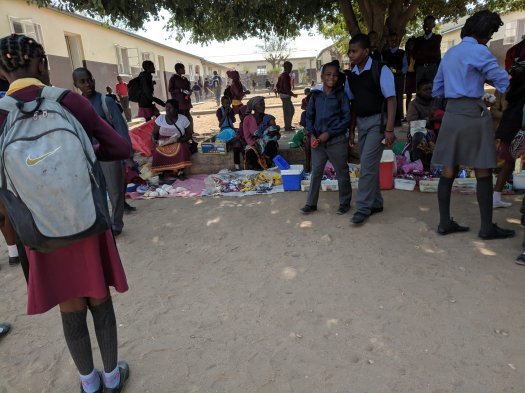
Vendors selling sweeties,fat cakes, fruit during break

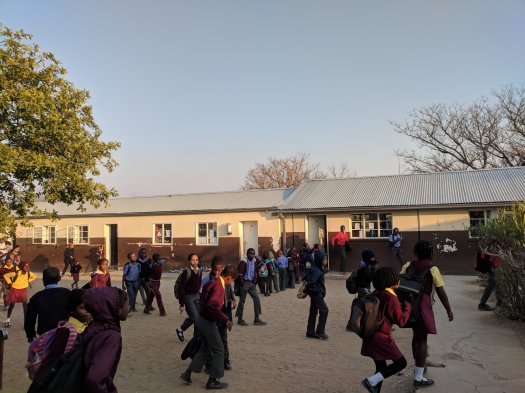
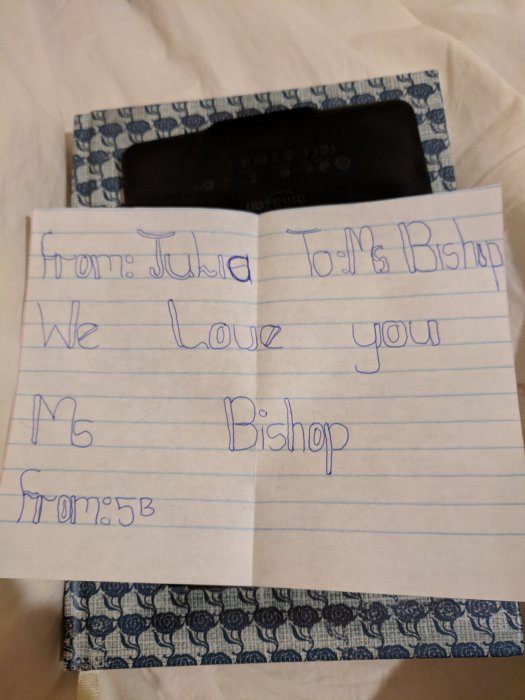
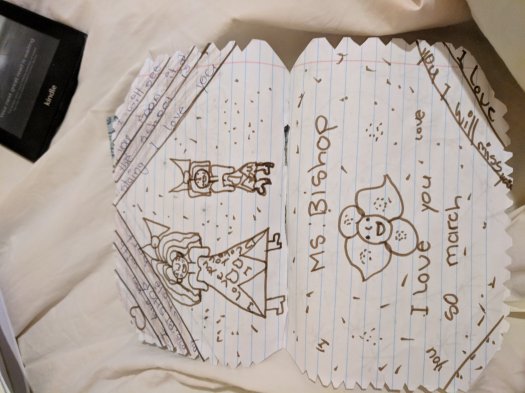
(For some reason I can’t get captions on the other photos. Photo 2 There are roughly 1450 learners at this school, grades 0-10. There are 8 other buildings similar to what you see here. Photos 3&4 are “love” letters from my learners. We all get them. We are like celebrities on campus

I have two interesting things to share that happened at school this week. After completing the 5th grade lesson with some time to spare, I was reviewing long division with my learners and decided to “check it” using multiplication. When I completed the multiplication and added the remainder and the result was the same as what we had been dividing, the class thought it was like magic. They said, “Do another, do it again” and we did until the class was over. It was the first time they saw how to do this.

In another class, I let them ask some questions about me. They already knew that I had five children and 8 grandchildren. One boy asked if I beat my children. I said my children are grown and bigger than me now, but no, I did not beat them. He kind of laughed, so did others, and some shook their heads – kind of like they were scoffing at me. “But”, I said, “I did punish them.” I would have said “consequences” or “discipline” but “punish” was the only word I was certain they understood. He asked what I did. I said I made them go to their room, I took away privileges like TV, phone, friends. I made them do extra chores and rarely, if they were especially bad, I sent them to bed with no dinner. There was a collective gasp, nodding of heads, and they understood I was not weak.

All for now, with all my love

Week 5 in Namibia-start SBT

This past week included the first of three weeks of observing classes and co-teaching at a local school. Each of our language groups have been assigned to different schools for School Based Training (SBT). The first week included guided tour of the school, attending the morning staff meetings, observing as many classes as we could, and 2 hours of language training while at the school. Our language trainer came to the school with us and we were provided space for our lessons. I observed 7 math and science classes for grades 4-6, an 8th grade Afrikaans class, and two 9th grade math classes.

The next two weeks I will create lesson plans and co-teach two 5th grade math classes per day. I will assist the regular teacher this week and next week I will be the lead teacher with the regular teacher assisting me. We will also continue a minimum of 2 hours language training during the school hours.

These are not like your typical American classrooms. The norm at this school (not all schools) is about 40 learners/class with one teacher. The learners usually share a textbook and the textbooks are not taken home. Some learners share a chair, but they don’t seem to mind.

Corporal punishment is illegal in Namibia schools, but it is a cultural norm that is slow to change. I did not witness it this week although several teachers carried 2ft lengths of garden hose or plastic pipe and would slap it on a desk or into their hand while walking around the class. Pretty intimidating to me!

The school day is 7:15am-1:05pm with a half hour break at 10. The learners do not eat lunch at school but have a snack during the break. There are vendors selling fat cakes, fruit, meat, and sweets or they bring something from home.

After our school day, we are taken to the PC Training Center for more training. We’ve had sessions on “Feedback and Error Correction”, “Teaching in Large Classrooms”, “Teaching with Minimal Resources”, and other useful teaching techniques. We also had sessions on “Domestic/Partner Violence”, “How to Deal with Unwanted Attention”, and other safety/security topics. Whew, my brain is on overload.

All for now, with all my love


GranEllen – week 3 as a Peace Corps Trainee (PCT) in Namibia

Below:

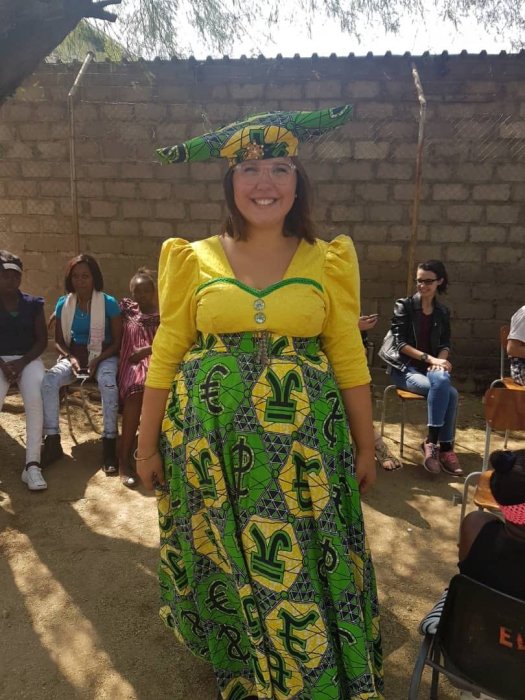
PCT in traditional dress from host family.

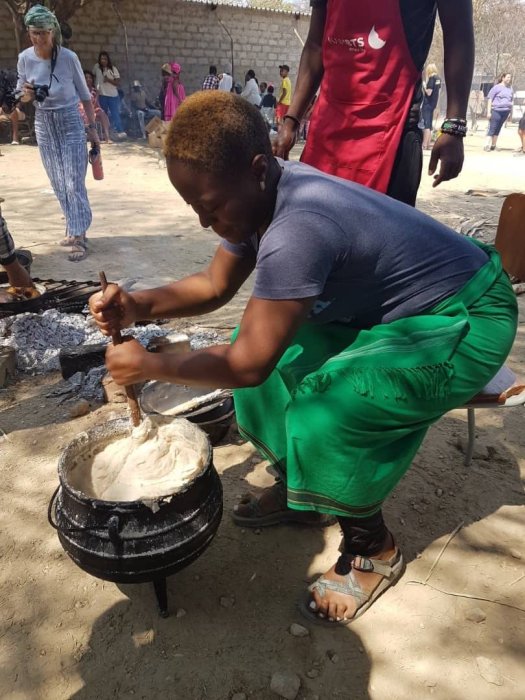
Another PCT preparing pap, porridge.

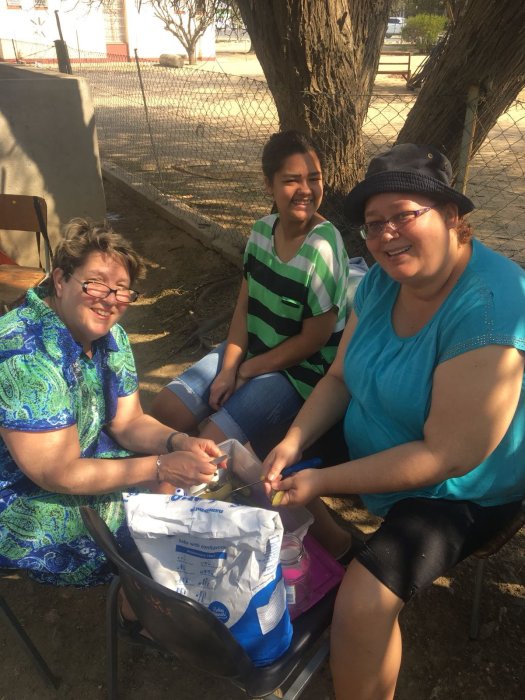
Me, helping with food prep.

This week focused on the cultural differences in Namibia, Safety and Security especially in the context of living among multiple cultures, personal and mental health care, climaxing with a Cultural Cooking Day. I learned that the best way to protect myself is to integrate well into my community. The more the locals know me, the more they will look out for me and will come to my aid if needed. Peace Corps is teaching 8 different languages to my Group 48 but there are many more languages spoken in this extremely diverse country. I am learning Afrikaans but it is very beneficial to know greetings in other languages because many tribal peoples are migrating for work opportunities. Even small amounts of language will go a long way to integrate into the local community. The reason we teach in English is because the government learned early on that it would be impossible to educate their population using a dozen different languages, especially if many are moving and the languages are not localized anymore. Primary grades 0-3 are taught in the learner’s mother-tongue and from then on they are taught in English.
Peace Corps also takes our personal and mental health care very seriously. They have a counseling service, assigned medical staff, and we received our medical kits. We’ve had multiple sessions on what to do if we get sick and the medical kit is well stocked with OTC medications, chapstick, bug spray, sunscreen, saline solution, bandages, and more. In addition, we practiced how to do a pin-prick malaria test (I’m negative), we’ve had 2 out of 3 rabies shots, hepatitis B shot, typhoid booster. We’ve been prescribed a malaria prophylactic to reduce the chance of malaria or its effect. I am very impressed with the attention to detail and the thorough training. The manual is very comprehensive including prevention, symptoms, and care for just about anything that could happen to us here in Africa.
All of our host families were invited for our Cultural Cooking Day. Each of the 8 language groups prepared food with our host families helping us. Two goats were slaughtered and a number of chickens. There was donkey meat, beef, and an assortment of fish. The mohangu was prepared and made into pap. There were fat cakes, sautéed spinach, fire roasted bread, mopani worms and more. We also prepared entertainment for our host families – we sang and/or danced to a traditional song. It was fun but exhausting!

GranEllen – week 2 in Namibia


IMG_20180825_213208
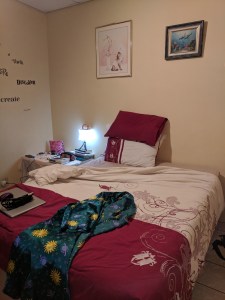
My new room
IMG_20180822_155745
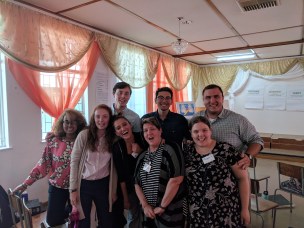
my Afrikaans language group

Week 2 was all about preparing for our training homestay. This is when we move in with a host family for the remainder of our training time. Our host family is determined by our assigned language so they can practice our new language with us in a home setting. On Wednesday afternoon my language was revealed as Afrikaans and that evening I met my host mother and daughter (18yr). My host father works out of town and the son (15yrs) is visiting other family since this is a school break right now. Peace Corps makes this a fun and exciting day by making a game out of the “language reveal” and later “finding” our host family.  PC Staff gives each Peace Corps Trainee (PCT) a piece of a puzzle for their language group. We then find similar pieces from other PCTs and complete our puzzle to know who all is in our language group. The language instructor finds their group and then we know our language because we have been working all week with the language instructors learning basic greetings for their specific language. It was a fun activity. That evening, after all the host families arrived, we did a similar activity except this time each PCT and each host family was given a puzzle piece and we had to match the 2 pieces to complete the simple puzzle. This is how we ‘found’ our host family.

I moved in with my host family Friday evening and I lucked out. They have been hosting volunteers for 10 years so they know what they are doing. I have my own room and the accommodations are very comfortable. I will be picked up by a PC van every weekday morning at my ‘bus stop’ around 7am for a day of training and then returned around 5:30pm. Weekends will mostly be spent with my host family unless PC has a field trip or other activity planned for us.

IMG_20180824_165538
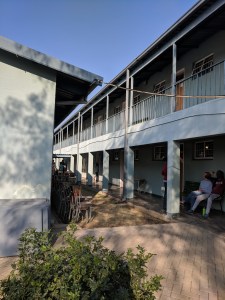
training center, our dorm rooms are on the right corridors and the meeting room is on the left
IMG_20180825_182922
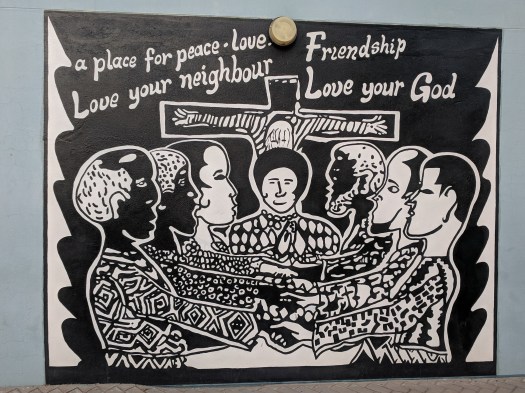
mural on the meeting room wall

GranEllen’s 1st week in Namibia

Everything is different yet everything is the same. I really enjoyed my first week as a Peace Corps Trainee (PCT) even though the travel was much longer than expected, there was a major sadness that turned our group into Namily (Namibia family) quicker than expected, and there is sand and dust everywhere.

Despite the major and minor challenges, Group 48 is strong. We laugh a lot, we play a lot (spike ball, Uno, volleyball, ucher, hearts, spoons, etc), we help each other with lessons, but mostly we support each other.
All for now with all my love.

Peace Corps Expectations

I bolded the parts that particularly resonate with me. They may be particularly difficult or particularly important or both.

  1. Prepare your personal and professional life to make a commitment to serve abroad for a full term of 27 months. 
  2. Commit to improving the quality of life of the people with whom you live and work and, in doing so, share your skills, adapt them, and learn new skills as needed.
  3. Serve where the Peace Corps asks you to go, under conditions of hardship if necessary, and with the flexibility needed for effective service.
  4. Recognize that your successful and sustainable development work is based on the local trust and confidence you build by living in, and respectfully integrating yourself into, your host community and culture.
  5. Recognize that you are responsible 24 hours a day, 7 days a week for your personal conduct and professional performance.
  6. Engage with host country partners in a spirit of cooperation, mutual learning, and respect.
  7. Work within the rules and regulations of the Peace Corps and the local and national laws of the country where you serve.
  8. Exercise judgment and personal responsibility to protect your health, safety, and well-being and that of others.
  9. Recognize that you will be perceived, in your host country and community, as a representative of the people, cultures, values, and traditions of the United States of America.
  10. Represent responsibly the people, cultures, values, and traditions of your host country and community to people in the United States both during and following your service.


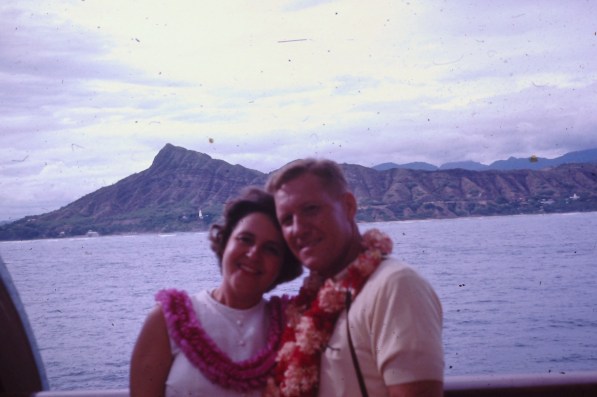
This photo is circa 1966 of my loving parents when we lived in Hawaii. They set high expectations too!

DSC00021 (1)