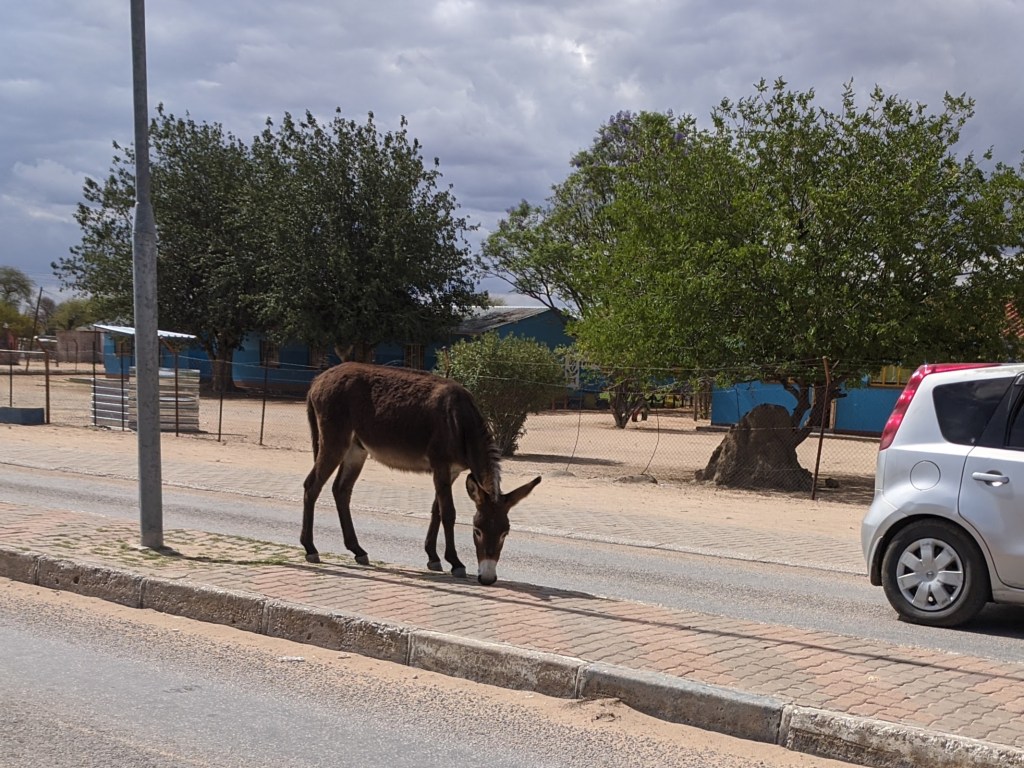
Donkey in Okakarara 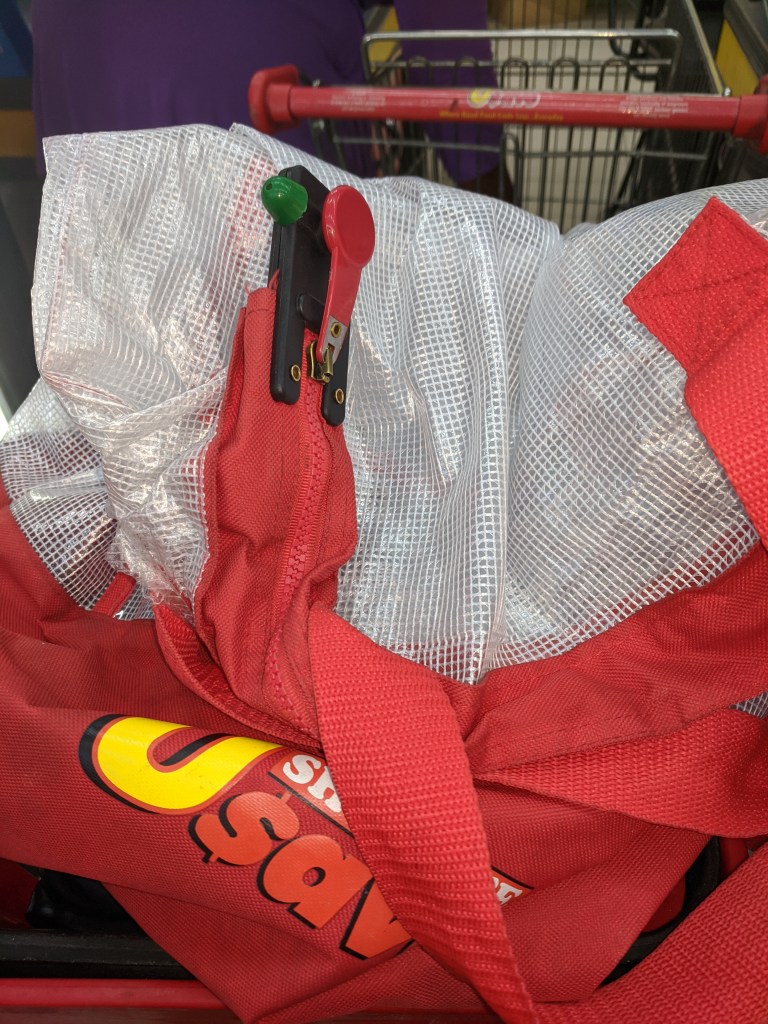
lock bag at Usave in Okakarara 
matchbox nativity set
It’s been a fun and somewhat productive week. One of the new volunteers in my town had asked me to teach her to bake and she especially likes chocolate. I taught her how to make brownies. Unfortunately, due to different pan sizes and oven temperature variations, they were more like ooie, gooie fudge than brownies but they were still yummy, especially with ice cream. That is the fun of baking; it is hard to have a complete fail.
I visited PCV Zach in Okakarara, about 100km from me, on Saturday and Sunday. He had one of his famous braai (i.e. BBQ) so there were other PCVs as well as some of his co-workers and neighbors. Zach is in the Community Economic Development (CED) sector of Peace Corps, so his PC experience is very different than mine. He helps individuals develop business plans, he provides business education and training, and basically does whatever he can to support and develop business in his town and region.
Many people in Okakarara are not originally from there and they go home when school is on break. Most people in this town are Herero (about 7% of total Namibia population), the people most decimated by German colonization and according to the UN Whitaker Report on Genocide, one of the first examples of genocide in the 20th century. Cattle is king in this culture, as in many Namibian ethnic groups, and many people will go to their family farm when possible. The rest of the population in Okakarara is mostly Owambo (pronounced Ovambo, accounting for 50+% Namibia population) and they will return to their homesteads in the far North. Since so many had already left for their farms and homesteads, Okakarara was quiet during my visit but I can tell from the people still here that it is very lively when everyone is back in town.
I enjoyed getting to know other PCVs on this trip, and Zach’s colleagues and friends. As one man was saying his goodbyes, he commented on how much he enjoyed our company. He said he often doesn’t talk to white people because they feel closed and not approachable. He doesn’t dislike us, but it doesn’t seem worth the effort. He said he could tell we PCVs were different. We were welcoming and open and genuinely interested in him, his friends, his culture, and he appreciated it. Obviously, that made us all feel good and even more glad that we came.
I spent a fair amount of time talking to Chris, a name given to him by a volunteer (not a PCV) teacher who could not pronounce his given name. He loves cooking and watches the food network. His English is exceptionally good, and his dream is to visit America. We talked about fresh herbs, Mexican food, baking, and other foody things. He started asking about my life here and my family in America. When I told him my first born just turned 43, he asked “How old are you?” I said 62 and he said, “No way, I thought you were mid to late 40s. You must take very good care of yourself!” How can you not like that???
Pictures: 1. Seeing donkeys, goats, sheep in town will never bore me. 2. I had to put my purse in a lock bag at the usave grocery store in Okakarara. They unlock it when you pay. In Otjiwarongo they have a place to check your bags and packages but you don’t have to check your purse. 3. matchbox nativity that I brought with me from the USA
 Where's GranEllen?
I have followed you from the start. You must write a book about your terrific experiences! I am so impressed by your story-telling – thank you for sharing so much about your everyday life-events and enlightening us all to different perspectives in the larger world.
LikeLike
Good to hear from you, David. I think about you often and hope you are doing well. I really appreciate your positive feedback. Sometimes I think I must sound so goofy but as Popeye the sailor man used to say, “I am what I am and that’s all I am”
Thanks again, it means a lot to me
LikeLike
I see a book in your future
Enjoy- love
LikeLike
I see a book in your future
Enjoy- love
LikeLike